
How to Use This FAQ Page
We have streamlined our FAQ section to make your search for answers as efficient as possible.
This page is divided into five distinct categories, arranged from top to bottom:
Logistics
FROTh
ATSI
Ashiatsu
Therapeutic Massage
Please scroll to the relevant section for your specific questions. If you have any inquiries that aren't covered here, please email us with your question at info@sterlingtouhmassage.com and we will be in touch.
sterling touch

-
We are nested in the heart Essex, VT. Just a block away from 5 corners. Our exact address is 16A Railroad Street. Essex Jct, VT 05452
-
We are open by appointment only. Please check our booking page or contact us for current availability.
-
We are not wheelchair accessible at this time. Our space has stairs at the entrance. Please let us know if you have mobility concerns and we will do our best to accommodate your needs.
-
We do not bill insurance directly. We can provide a receipt for you to submit to your insurance company for out-of-network reimbursement if your plan covers massage therapy.
-
We encourage cash but we accept credit and debit cards. Payment is due at the time of service.
-
We require at least 24 hours notice for cancellations. Late cancellations or no-shows will be charged 50% of the session fee. This policy ensures we can respect our time and the time of other clients.
-
You can book online through our website. You can also email us at info@sterlingtouchmassage.com We will respond within 3 business days.
-
Yes. Gift certificates are available for any service. They make a great gift for someone who needs real pain relief, not just a spa day. Go to Gift Certificates in the drop down menu at the top right corner of your screen.
-
Please answer intake form out prior to your appointment. Plan to arrive 5–10 minutes early . We will talk about your goals, any pain or injuries, and what you want from the session. Then we will begin the bodywork. After the session, we check in and answer any questions.
-
Yes!
Pull into the Vermont Med Spa parking lot, the back of the building, where our entrance is located. We have free parking. No need to feed a meter or walk far.
There is also free street parking across the street and free public parking on the other side of the train tracks, behind FireBird Cafe.
-
Yes. We hear this often. Many people have had experiences where they did not feel heard or felt uncomfortable. We prioritize clear communication and boundaries. We will check in with you throughout the session. You are in control.
-
Yes. If you need a support person for comfort or accessibility, they are welcome to be in the therapy room with us while we work or in the transition room (waiting area).
-
Yes. We have a bathroom on site for client use.
-
We are only on Instagram and don’t post too much. You can definitely give us a follow for updates, appointment openings and other stuff when we do post. lol
FROTH

-
FROTh is a gentle, non-invasive bodywork technique. The practitioner uses subtle rocking, shaking, and stretching to create oscillation in your fascia. This helps your nervous system release deep-held tension.
-
It is not massage. It is not about stroking the muscles to relax. FROTh uses gentle motion to communicate with your nervous system. Your body lets go naturally, not because someone pressed hard.
-
It feels gentle. You might feel like you are being gently rocked or floated. Some people describe it as "tissue softening" or "a wave moving through their body." It can feel deeply relaxing and freeing.
-
People who need a gentler approach. Anyone with chronic tension. Those who have had trauma and cannot tolerate deep pressure. Movement professionals. Anyone whose body feels "stuck."
-
Yes. You wear comfortable, loose clothing. The practitioner works through your clothes. There is no oil or lotion used.
-
Yes. Especially pain related to nervous system tension. Headaches. Jaw tension. Back pain. Neck tightness. When your nervous system relaxes, muscles follow.
-
FROTh helps with:
Chronic tension that does not release with deep work
Nervous system hyperarousal (always feeling "on edge")
Trauma held in the body
Headaches (tension and migraine)
TMJ / jaw tension
Whiplash and neck stiffness
Anxiety-related muscle tightness
Insomnia and poor sleep quality
Chronic fatigue
Fibromyalgia and widespread pain
Post-concussion symptoms
Pelvic floor hypertonicity
Breathing restrictions
Stiffness that feels "frozen"
Recovery from high-intensity training
Feelings of being "disconnected" from your body
FROTh does not force tissues to release. It creates conditions for your nervous system to allow release naturally. The body lets go when it feels safe.
Anatomy Trains structural integration (ATSI)

-
ATSI is a form of bodywork that reorganizes your body's connective tissue (fascia) to improve posture, movement, and pain patterns. It follows the Anatomy Trains maps developed by Thomas Myers.
-
Massage typically focuses on relaxing muscles. ATSI works with fascia, the web of connective tissue that holds your whole body together. It looks at your entire body pattern, not just one sore spot.
-
It can be intense. The work goes deep into fascia. But we communicate constantly. You control the pressure. We want productive work, not pain for pain's sake.
-
The classic series is 10 sessions. Each session builds on the last. Some people do all 10. Others do 3–5 and feel lasting change. It depends on your goals and your body.
-
Wear comfortable clothing you can move in. Underwear or shorts and a tank top work well. You stay clothed during the session. We need to see your body's movement patterns.
-
No. Anyone with a body can benefit. Desk workers. Retirees. Dancers. Construction workers. If you have posture or pain issues, ATSI can help.
-
We start by talking about your goals and any pain. Then we assess your posture and movement. Then we work on specific fascia lines using hands-on techniques. We check movement again before you leave.
-
ATSI helps with:
Chronic back pain (lower, middle, upper)
Sciatica and hip pain
Neck and shoulder tension
Forward head posture ("tech neck")
Rounded shoulders
Uneven hips or leg length
Plantar fasciitis
Knee and ankle issues
Headaches and migraines (posture-related)
Jaw tension and TMJ
Repetitive strain injuries
Post-surgical scar tissue restrictions
Breathing restrictions (rib and diaphragm tightness)
Pelvic floor tension
It does not "fix" in the sense of curing a disease. It reorganizes your fascia to restore balance. When your structure is balanced, pain often resolves on its own.
ASHIATSU
-
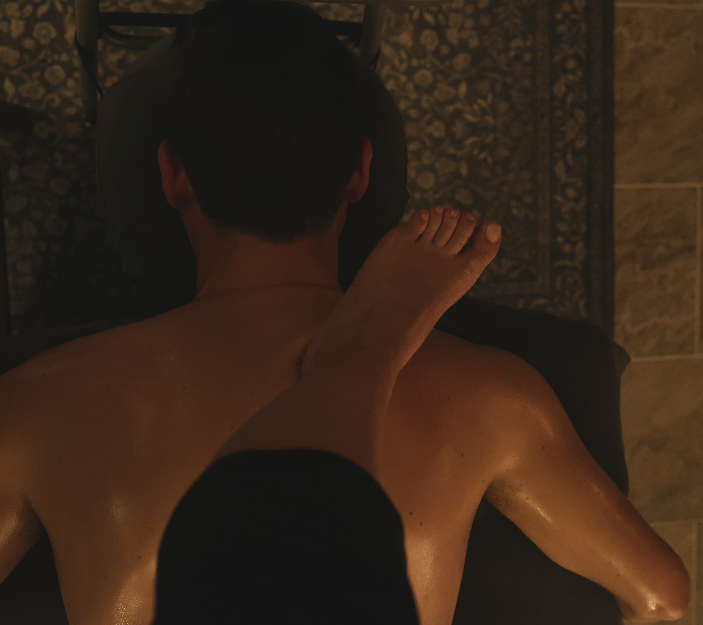
Ashiatsu is a type of massage where the practitioner uses their feet instead of their hands. The therapist uses overhead bars for balance and control. The pressure is broader and more even than hand massage.
-
It can be deep, but it should not hurt. The broad surface area of a foot distributes pressure differently than a hand or elbow. This allows deep work without sharp, bony pressure.
-
It feels like a deep, smooth ironing out of tension. Many people describe it as "more pressure than hands can give" but "not as pokey." It is often described as deeply grounding.
-
People with chronic muscle tension. Anyone who feels like hand massage is not deep enough or those who are ticklish. Athletes. People who sit all day. Anyone with large muscle tightness in their back, glutes, or legs.
-
Yes. The pressure is completely controlled. We can make it very light. Ashiatsu is not automatically deep. We work with your comfort level.
-
Regular deep tissue uses hands, elbows, or forearms. Ashiatsu uses feet. The pressure is wider, more even, and can go deeper and keep consistent pressure without discomfort. It also allows the therapist to work longer without fatigue.
-
Yes. Overhead bars are used for balance and pressure control. They allows the practitioner to work with their full body weight in a controlled way.
Ashiatsu is also practiced from a seated position, allowing the practitioner to access an ideal angle to massage the pectorals, trapezius and back.
-
Ashiatsu helps with:
Lower back pain (acute and chronic)
Sciatica
Piriformis syndrome
Tight glutes and hips
Hamstring tightness
Upper back and shoulder tension
Thoracic spine stiffness (mid-back)
Headaches related to neck and shoulder tension
Leg fatigue and heaviness
Plantar fasciitis
IT band tightness
Postural tension from desk work
Athletic recovery (especially runners, cyclists, weightlifters)
Nervous system regulation (grounding, calming)
General stress and muscle guarding
People who feel "touch starved" but need more than light pressure
Ashiatsu gives broad, even pressure that reaches large muscle groups. It is especially effective for people who hold chronic tension and postural pain.
THERAPEUTIC MASSAGE

-
It is a customized blend. Julian uses gentle FROTh oscillation, Swedish techniques for relaxation, and myofascial release informed by ATSI principles to address tension.
-
Spa massage is often generic. Same routine for everyone. Julian’s Therapeutic Massage is responsive. Adapting to what your body needs that day. No cookie-cutter sessions.
-
It varies. Some parts feel like gentle rocking (FROTh). Some parts feel like a traditional Swedish massage (long, flowing strokes). Some parts feel like focused work on tight fascia (myofascial release). It is a conversation between your body and our hands.
-
People who want a gentler, more responsive approach. Anyone who does not need deep tissue but still wants real results. People who are new to bodywork. Anyone who has had a bad massage experience before. People who want to feel safe and listened to.
-
No, you undress to your comfort level. You are draped with a sheet. Only the area being worked on is exposed. We use oil or cream.
-
Yes. Especially for people who find deep tissue too intense. The blend of FROTh + Swedish + myofascial release addresses pain gently while still getting results.
-
General muscle tension
Stress and anxiety
Headaches and migraines
Neck and shoulder tightness
Lower back discomfort
Poor sleep quality
Fatigue
Nervous system overload
Recovery from daily life
People who are "too sore" for deep work
Anyone needing nervous system regulation